If you depend on CPAP, a portable battery backup power station can be seen as essential equipment. Whether you need emergency power during an outage, or simply want to enjoy camping outdoors, battery power is the best solution when there is no power supply. This article is going to answer all your CPAP questions, with special emphasis on battery backup power for these devices.
How do you make the most of your CPAP when running on battery backup? What can you do when the battery runs out? Can you use more than one CPAP machine on a portable battery station? If you’re looking for answers to these questions, keep reading. I’ll be supplying the answers and more. I’ll also be reviewing a couple of the best portable power stations for CPAP.
Optimizing Your CPAP Battery Usage
When the lights go out, you can never be too sure how long you’ll need to rely on battery power to keep your CPAP functioning. Perhaps you’re going to camping for a few days and need to get the best performance from your CPAP battery backup.
Even the best battery power station has its limitations. You will often find claims that a particular CPAP emergency battery backup can supply enough power for 60-hours, possibly more. Though, these long battery usage times depend on how you use your CPAP. In order to get the longest battery time, you’ll need to optimize your CPAP settings.
Essentially, a CPAP machine is a pump that supplies more air to assist your breathing. They will have other functions too, like a humidifier and heater. All these functions require power. The more power you use, the less time you’ll get from your batteries. This should be obvious. By changing your CPAP settings to maximize your power usage, you could drastically increase the operational time from your CPAP machine.
Instead of using the automatic function, set your CAPAP to the lower pressure setting (Psi). Turn the heater unit and humidifier off to save power. Every watt of power you save, will extend the amount of time that you’ll get from your battery power pack.
CPAP Battery Backup Reviews
If your CPAP machine is important to you, a battery backup station is probably the best way to ensure that you always have the electricity needed to keep it functioning, regardless of where you may be. A basic battery backup station for CPAP need not be too expensive.
You can opt for more power, to run more than just a single CPAP. These battery backup units will obviously cost more. Though a more powerful battery backup can power a CPAP (or several CPAP) machines, along with lights, a TV, laptop, even a small camping refrigerator.
We’ll be reviewing 4 of your best options for a battery backup power supplies for camping or home use. These will range from small, relatively inexpensive units for a single CPAP, up to larger units that can supply more power for longer periods of time.
1. MAXOAK CPAP Battery Backup
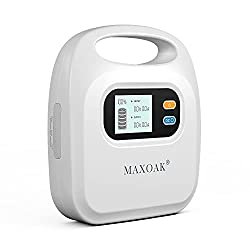
The MAOAK CPAP battery backup is designed specifically for CPAP machines. The unit is supplied with connectors for most popular CPAP machines. Because this battery backup power supply is designed for CPAP, power usage is optimized. This is achieved by supplying the precise voltage required by CPAP manufacturers (12V/5A; 15V/4A and 24V/4A). It also has a fast charging 5V USB port and a conventional USB port.
Because the MAOAK battery backup unit doesn’t use an inverter, power loss is kept to a minimum. This means a smaller battery and no bulky inverter. The unit weighs only 4.1 pounds and is incredibly compact (8.7” X 2.5” X 7.9”). The 297WH lithium ion battery can supply a single CPAP for up to 55-hours – depending on the CPAP model and user settings. Even when using extra power for the humidifier and/or heater, you should expect at least 40-hours operational time for most CPAP machines. It takes about 5½-hours to recharge the battery, using the 120V AC charger supplied with the MAXOAK battery backup system.
2. PRYMAX Portable Power Station, 300W
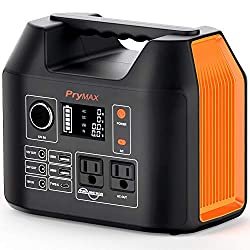
The PryMax Portable Power Station is much more than an emergency power supply for a single CPAP machine. It has a pure sine wave inverter that can provide 300W continuous power and 600W surge power. So you can also use it supply a TV or similar AC electric appliance. In addition to this, it has DC output ports for 12V and 24V, as well as 2 X 5V USB ports.
The 298WH lithium ion battery will be able to supply power to most CPAP machines for around 50 – 55-hours when using low power settings (low pressure, no humidifier, no heater).
This would be if your CPAP is able to run directly from the 12V or 24V outlets. Using the 120V AC (inverter supplied) outlet and your CPAP AC power supply will reduce this time by up to 25%. It has a 19VDC input that allows you to charge the internal battery using the AC charger (supplied with the battery pack) or you can purchase a solar charger kit, offering you greater versatility when camping.
3. Jackery Portable Power Station Explorer 240
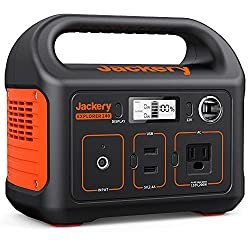
Of the inverter battery power stations featured in this review, the Jackery Explorer is probably the least accomplished. Though you may be able to find it at a cheaper price. The battery has as slightly lower rating and it doesn’t supply quite as many AC watts.
A 240WH lithium ion battery means a little less battery time, when compared to most others in this class of battery backup systems. None the less, you should be able get close to 50-hours usage for an average CPAP machine, if you don’t use the humidifier or heater.
Though, this time can only be expected if your CPAP machine uses a 12VDC input current. For any other operating voltages, you’ll need to use the 120V inverter supplied output and this means a power loss factor that reduces battery time.
An inverter supplies 200W continuous 120V AC power, with a peak capacity of 400W. It has 2 X USB ports and a 12VDC output port. An AC wall charger and 12V car charger are supplied with the Jackery Explorer battery power station, and you have the option to buy a solar charging kit.
4. ROCKPALS 300W Portable Generator Lithium Portable Power Station
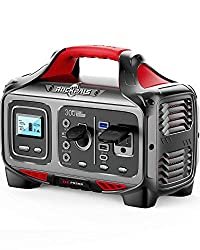
The Rockpals 300W portable solar generator is very similar to the Prymax Portable Power Station reviewed above, both in its price and capabilities. The Rockpals battery station also includes an inverter that can supply 120VAC output power – 300W continuous output and 600W peak power.
The Rockpals portable solar generator can supply 12VDC and 24VDC power. It also has standard and rapid charge USB ports. The 280AH lithium ion battery matches the other two battery backup stations reviewed this far.
It should keep a single CPAP powered for up to 50 – 55 hours using the DC outlets. Using AC power will, as with any inverter power supply, slightly reduce your runtime.
You have three options for charging the battery: an AC wall charger and 12V car charger are supplied with the machine. You can also purchase the optional solar charging kit.
5. Goal Zero Yeti 400 Lithium Portable Power Station
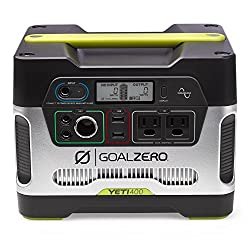
The Goal Zero Yeti 400 Lithium Portable Power Station is probably the best small portable battery backup system of its kind. The most remarkable difference between the Yeti 400 and all the other battery stations in this review, is the remarkable battery storage capacity.
I should mention that this is also the most expensive battery backup system featured in this review. Though, if you want extended usage from your battery, it’s worth it. The 428WH battery, offers almost twice the power storage capacity, when compared to any other in this review.
This should provide you at least a week of CPAP use for an average 8-hour sleeping pattern. The inverter is capable of supplying 300W 120VAC power continuously, with a whopping 1200W surge capacity. It also 2 X 12VDC output ports, and 3 X 5V USB ports.
You have great versatility when charging the Goal Zero Yeti 400, using either a 120V wall charger or a solar kit.
How to Find a Campsite with Emergency Power
If you’re going to depend on an electric supply whilst camping, it isn’t always that easy to know what to expect. Many private camping grounds offer full amenities, and these will include an electric outlet for RVs.
Most US national parks, state parks, local parks, and government recreational areas, only provide basic facilities, like picnic tables, drinking water, and toilets. Some may include showers. However, you won’t be guaranteed of an emergency electric supply. Visiting websites that offer guidelines for camping in the US, it becomes clear that a portable electric power supply is almost a necessity if you want to be sure that you’ll have electricity when camping. This means a portable generator or battery station should be an integral part of your planning for a camping trip.
CPAP Backup Battery - FAQ
Can You Power 2 CPAP Machines with one Battery Pack?
Most CPAP machines draw around 30 – 60 watts of power. You’ll need to check the rated output of the portable battery power station that you’re using. Some will supply up to 600W or more. This means that you can use several CAPAP machines and some other equipment. If you intend using 2 CPAP machines, ensure that you select a portable battery station that can supply at least 100W rated power, preferably more .
Remember that rated power is the continuous wattage that a battery pack can supply. Peak wattage can only be supplied for a short period. So you need to check that the rated (or continuous) power output for the battery station that you’re using matches the power requirement for both CPAP machines.
You should also keep in mind that 2 CPAP machines will use twice as much power. You’ll need to consider the battery storage and charging options to ensure that you have the battery storage capacity to meet your needs.
What Happens When Your CPAP Battery Pack Runs Out?
A CPAP battery power pack is only useful for as long as the battery has enough power to supply your CPAP. When the battery runs flat, that’s the end of the road. You will no longer be able to use your CPAP. If you’re going to rely on your CPAP battery power station when camping, check what your charging options are.
Some CPAP emergency battery stations can only be charged using a 120V AC power outlet. If you have no access to a power socket, you won’t be able to charge the battery station. There are several portable battery packs that can be charged using a 12VDC power source. This makes it possible to charge the battery pack using the auxiliary outlet in your car. There are also compact solar charging options. These will allow you to charge your CPAP battery backup whenever sunlight is available.
Can You Carry Battery Packs or Power Stations on a Plane?
The Transportation Security Administration (TSA) and the Federal Aviation Administration (FAA) have strict regulations regarding lithium ion batteries on planes. Many portable battery power stations do not meet TSA and FAA requirements.
You may only take lithium ion battery stations on a plane as carry-on luggage. Even then, you are limited to what batteries you can take with you. Passengers are restricted 100 Watt-Hours per battery. It’s possible to obtain airline permission to take additional batteries, up to 160 Watt-Hours.
Most CPAP machines utilize batteries that exceed these limitations, which is an inconvenience (to say the least) when travelling by plane to your vacation destination. Before you attempt to board a plane with your battery power station, check your battery size.
Battery specs are often listed as Ampere-Hours (AH) or milliamp-hours (mAh) . This can become confusing, since TSA and FAA battery restrictions are listed as Watt-Hours (WH). It is quite easy to convert your AH spec to WH. If the battery is specified using the suffix mAh, you’ll first need to convert this into AH. This means dividing the mAh rating by 1,000. For example, 82,000mAH / 1,000 = 82AH. Watt-Hours = Ampere-Hours X Voltage. You can check the battery voltage on the charger or in the users handbook. Make sure you use the specified input voltage. This may be different to the output voltage. If the battery used in the above-mentioned example has an input voltage of 25V, then you calculate your WH rating as follows: 82AH X 25V = 2,050 WH. It is quite obvious that this battery exceeds the maximum 100 – 160 WH allowed by aviation authorities.
Leave a Reply